S&P 500 — US Large Cap Index
 FTSE 100 — UK Blue Chips
 Euro Stoxx 50 — Eurozone Leaders
 DAX 40 — German Equities
 CAC 40 — French Market Index
 Nikkei 225 — Japan Benchmark
 Hang Seng — Hong Kong Index
 Shanghai Composite — China Mainland
 ASX 200 — Australian Market
 TSX Composite — Canada Index
 Nifty 50 — India Large Cap
 STI Index — Singapore Market
 KOSPI — South Korea Index
 Bovespa — Brazil Equities
 JSE Top 40 — South Africa Index
 IPC Index — Mexico Market
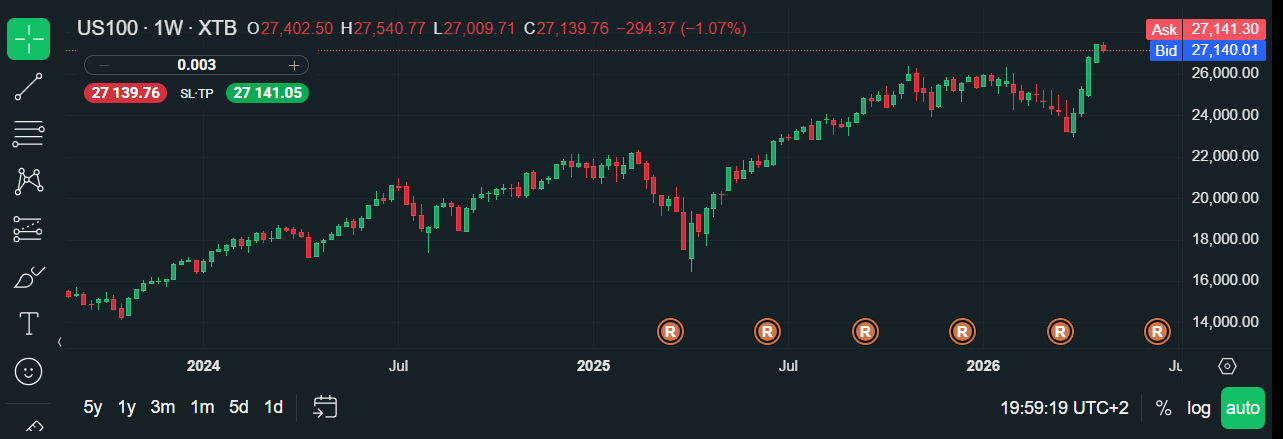
There was a negative tone to markets on Tuesday. US indices were lower, led by large declines for Nvidia, Intel, Sandisk, Arm Holdings and AMD. Fears about the uptake of OpenAI’s latest models is fueling the sell-off. This comes after OpenAI said that it has missed its own internal targets for revenue and sales figures. This is leading to questions about the sustainability of AI investment, and comes at a sensitive time for markets, the day before four of the largest hyperscalers report Q1 results.
AI ecosystem takes a hit from OpenAI news
This report is sending shockwaves through the AI trade. Arm Holdings, which was the best performing US stock last week, is down 8% today, Nvidia is down more than 2% and Oracle, who is a major investor in OpenAI is down 3%. Data centre stocks are also taking a hit, Vertiv is down 6%, and specialist AI fiber manufacturers are also lower by 8%. Tech is weighing on the main US index, and cancelling out a 6% jump for Coca-Cola, who reported stronger than expected earnings. There was also some good news for Jet Blue, a beleaguered low-cost US airline. The company’s stock price is higher by 3% today after it announced plans to manage higher fuel costs, which will boost fuel supply by 30-40%. Investors are cheering this news after a wave of concerns have hit the mid-market airline sector in recent weeks, including a government bailout for Spirit Airlines.
Can the Magnificent 7 deliver?
The market seems happy to scale back their positions in the tech sector ahead of earnings for Microsoft, Meta, Amazon and Google that are due tomorrow night. The fact that OpenAI is struggling with monetizing their AI products does not bode well for the hyperscalers, and investors are preparing themselves for the worst. It may not come to pass, especially since the likes of Microsoft and Google are much more established compared to OpenAI, have a larger customer base and more established products. However, OpenAI’s admission about sales and revenues could raise some uncomfortable questions around AI spend and investment plans. This is particularly relevant for Meta, as some have wondered how the company can monetize Mark Zuckerberg’s AI ambitions.
UAE leaves Opec, what it means for the oil price
While tech stocks are stealing the limelight, news that the UAE is leaving Opec has roiled the commodity space. The news is a major blow to Opec, which has held a tight fist on global oil supply for decades. However, the fact that a member as important as the UAE is happy to walk away is a sign that 1, the oil market is changing post the war in Iran, and 2, Saudi Arabia will have less control over amoothing the supply of oil in the future, which could make the commodity space more volatile in the future. The impact on the oil price has been minimal, although Brent crude has erased some earlier gains and is back below $111 per barrel. Understanding this decision by the UAE is important to try and gauge what it means for the oil market in the future.
Most analysts believe that the real reason behind the move from the UAE is that they want to pump more oil in the future without the constraints of Opec quotas. The UAE’s move is a sign that global oil producers could be gearing up for an oil grab, where demand will be high once the Strait of Hormuz is reopened. Thus, the UAE is positioning for a major revenue boost down the line and has expressed in the past an ambition to boost output by up to 25% to 5mn barrels per day.
Oil market backwardation is here to stay
Although the UAE’s decision to leave Opec won’t move the dial for the oil price right now, it could keep the oil market in backwardation, with future prices lower than spot prices. For now, the tch stock rally is on pause, which is hindering US stocks as they fall back from record levels. Today’s price action suggests that the hyperscalers have a lot to prove in their earnings reports this week, and the bar is high for another leg higher in US stocks.
Chart 1: US Nasdaq falls back from record highs
Source: XTB