S&P 500 — US Large Cap Index
 FTSE 100 — UK Blue Chips
 Euro Stoxx 50 — Eurozone Leaders
 DAX 40 — German Equities
 CAC 40 — French Market Index
 Nikkei 225 — Japan Benchmark
 Hang Seng — Hong Kong Index
 Shanghai Composite — China Mainland
 ASX 200 — Australian Market
 TSX Composite — Canada Index
 Nifty 50 — India Large Cap
 STI Index — Singapore Market
 KOSPI — South Korea Index
 Bovespa — Brazil Equities
 JSE Top 40 — South Africa Index
 IPC Index — Mexico Market
The market mood is upbeat as we move through Tuesday. US equity futures are edging higher, and the rally in some tech stocks is set to continue. Hopes are rising that the conflict between the US and Iran is in its end stages, after Iran announced that it would not let vessels pass the Strait of Hormuz in an attempt to keep peace talks with the US live. This comes after two Chinese listed vessels challenged the US blockade earlier this morning and passed through the Strait without any attempt by the US to stop them. For now, this is giving hope that 1, the Strait is passable and ships are not at risk of attack if they attempt to cross the Strait, and 2, that the peace process continues.
US stocks are rising on Tuesday led by the consumer discretionary, communication, and tech sectors, the energy sector is lagging as the oil price slips further and Brent crude is currently below $98 per barrel.
JP Morgan highlights risks for consumer and US economy
As events in the Middle East seem to de-escalate on Tuesday, the market can focus on other things including earnings. JP Morgan’s share price is expected to open down slightly on the day, after it reported Q1 numbers that were stronger than expected. JPM said that the consumer remained solid for now, but that a ‘complex series of challenges’ are ahead, due to the war and energy price volatility. JPM reported a 10% increase in revenues compared to a year earlier, at $49.84bn, ahead of the $49.1bn analysts expected.
Net interest income grew by 9 % to $25.48bn, however, investors were left a little underwhelmed by the $103bn of net interest income forecast for 2026 as a whole, which is why the share price is lagging on Tuesday and is down 0.4%. Like Goldman Sachs, JPM’s traders had a very strong quarter, with revenue jumping nearly $4bn to $23bn compared to a year ago. Investment banking fees also rose 28%. However, Goldman Sachs has less exposure to the real economy, and is outperforming its US banking peers this week.
JPM is more exposed to Main Street compared to many other banks in Wall Street, and the cautious outlook on the consumer, along with the prospect of slightly disappointing net interest income could hold back the stock today. This comes even as the broader S&P 500 continues to make gains and erode all of the losses incurred since the onset of the Middle East conflict.
Software stock rebound helps market recover from war shock
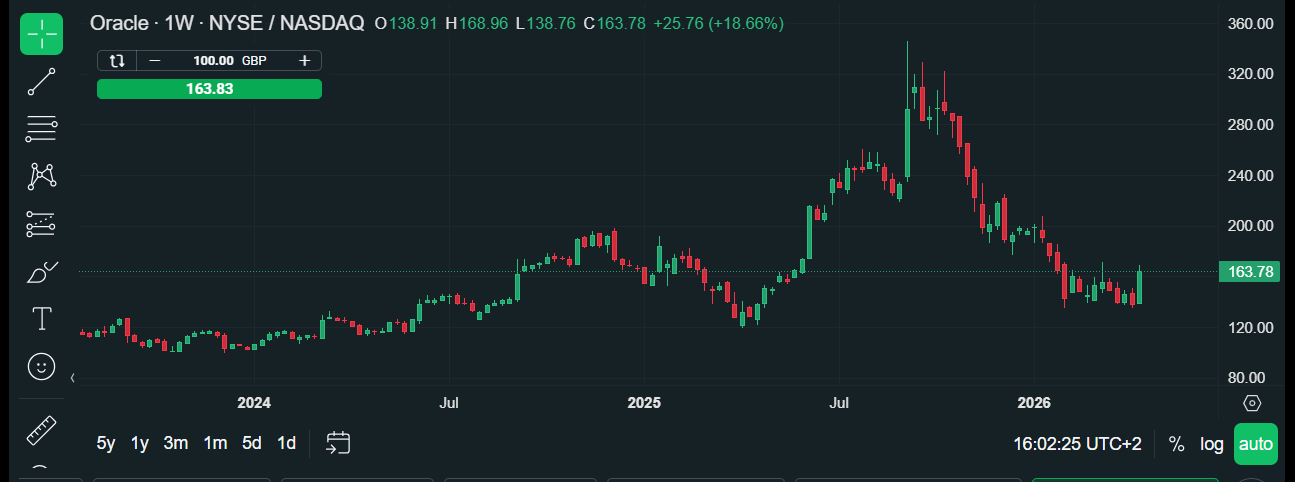
Beaten down software stocks bounced back sharply on Monday, and this trend looks like it is continuing. Oracle was a top performer at the start of the week, rising 12% and outperforming its peers, and it is extending gains once more on Tuesday and is up 6% at the start of US trading. This could be the start of a tech stock rebound, which may fuel US stock index outperformance for the rest of this quarter.
Oracle’s share price is still lower by nearly 50% since its peak in September after investors fretted about the impact of AI on its business model. However, investors are now starting to relax about the impact of AI. On Monday, Oracle showed the market the results of its huge AI investments at its Customer Edge Summit. Its technology is being used to help utility companies inform their customers how they can be more efficient with their energy consumption, which is saving US consumers $300mn a year. This comes at a time when energy prices are surging, and this development was warmly welcomed by investors.
In recent years, AI firms have been focused on telling us what AI technology looks like, now it is starting to show the world what AI utility looks like, and investors like it.
Chart 1: Oracle’s share price has had a strong run recently, but still has a long way to go
Source: XTB
Oracle has had a strong run in recent days, but there could be further to go as losses have been severe for the software sector in recent months. If the tech sector can lead the pack, then we could see US stocks start to outperform their global peers, after lagging for most of this year.
Downbeat UK news can’t stop the pound
The pound is extending gains today, as the dollar slips. It has brushed off concerns about the UK’s economic outlook. The IMF has downgraded the UK’s GDP forecast for this year to 0.8% down from 1.3% in January. This is due to higher inflation and reduced rate cut expectations. Added to this, a 10-year Gilt auction earlier on Tuesday saw the UK pay the highest yield since 2008. UK 10-year yields are down 5 bps today on the back of the falling oil price, but the price the government had to pay to borrow for 10 years was 4.9%, a significant premium on the 4.76% market price for UK 10-year bonds. In this environment you would assume that a government would halt borrowing, however, benefit costs ramped up at the start of April, which means higher debt repayments and erosion of the UK’s fiscal headroom in the coming months. If UK yields remain elevated for the coming months, and if there is no hope of a rate cut from the BOE this year, then the UK could find itself in a fiscal doom loop once more, and more hand wringing about the Budget could start to weigh on confidence.
For now, asset prices are willing to look through these risks and focus instead on continued hopes about a positive outcome for the war in the Middle East, which could shift expectations once more.
The material on this page does not constitute financial advice and does not take into account your level of understanding, investment objectives, financial situation or any other specific needs. All information provided, including opinions, market research, mathematical results and technical analyzes published on the Website or transmitted To you by other means, it is provided for information purposes only and should in no way be construed as an offer or solicitation for a transaction in any financial instrument, nor should the information provided be construed as advice of a legal or financial nature on which any investment decisions you make should be based exclusively To your level of understanding, investment objectives, financial situation, or other specific needs, any decision to act on the information published on the Website or sent to you by other means is entirely at your own risk if you In doubt or unsure about your understanding of a particular product, instrument, service or transaction, you should seek professional or legal advice before trading. Investing in CFDs carries a high level of risk, as they are leveraged products and have small movements Often the market can result in much larger movements in the value of your investment, and this can work against you or in your favor. Please ensure you fully understand the risks involved, taking into account investments objectives and level of experience, before trading and, if necessary, seek independent advice.