S&P 500 — US Large Cap Index
 FTSE 100 — UK Blue Chips
 Euro Stoxx 50 — Eurozone Leaders
 DAX 40 — German Equities
 CAC 40 — French Market Index
 Nikkei 225 — Japan Benchmark
 Hang Seng — Hong Kong Index
 Shanghai Composite — China Mainland
 ASX 200 — Australian Market
 TSX Composite — Canada Index
 Nifty 50 — India Large Cap
 STI Index — Singapore Market
 KOSPI — South Korea Index
 Bovespa — Brazil Equities
 JSE Top 40 — South Africa Index
 IPC Index — Mexico Market
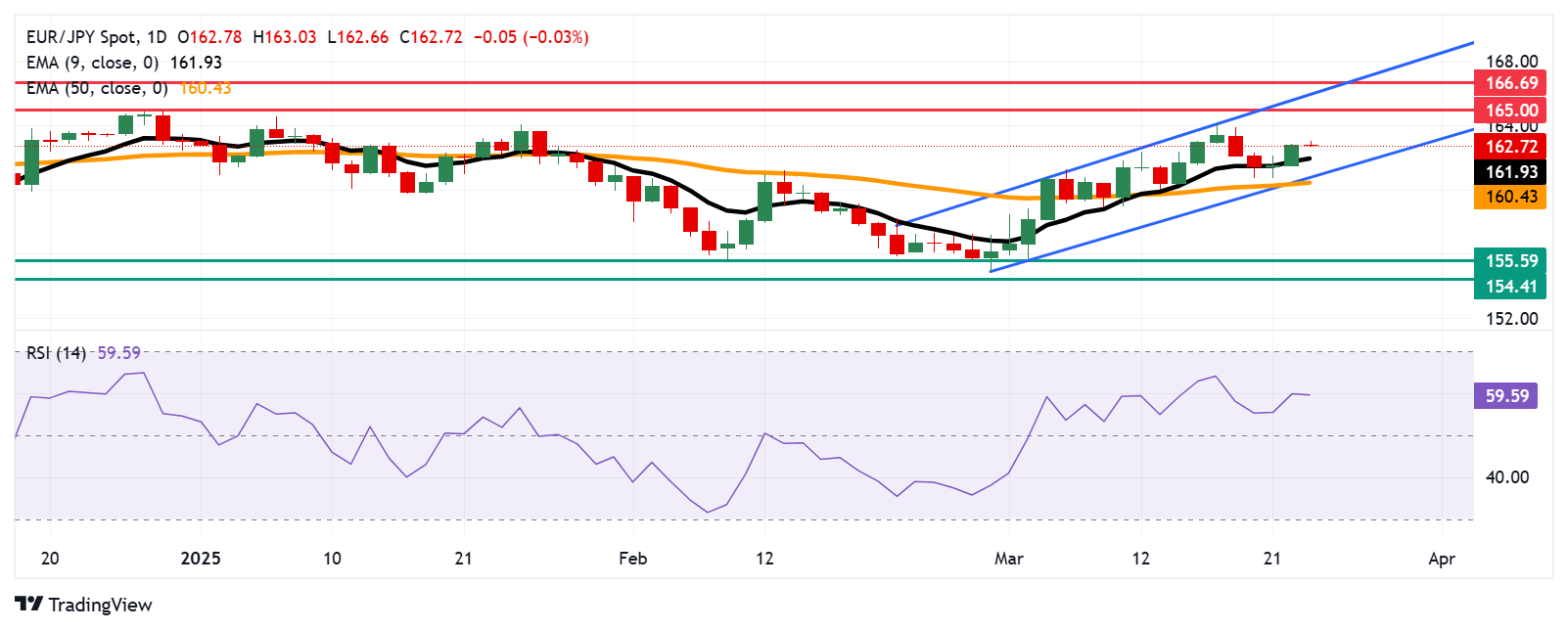
- EUR/JPY may encounter key resistance around the psychological level of 165.00, identified as “pullback resistance.”
- The 14-day Relative Strength Index remains above 50, reinforcing the bullish outlook.
- On the downside, initial support is seen at the nine-day EMA of 161.93.
EUR/JPY holds little losses near 162.80 during Tuesday’s Asian session after two consecutive days of gains. Technical analysis of the daily chart shows the currency cross trending within an ascending channel, reinforcing a bullish outlook.
Additionally, the 14-day Relative Strength Index (RSI) stays above 50, strengthening the bullish outlook for the EUR/JPY cross. The cross also holds above the nine- and 50-day Exponential Moving Averages (EMAs), highlighting strong short- and medium-term momentum and supporting the potential for further gains.
On the upside, the EUR/JPY cross may face its first key resistance around the psychological level of 165.00, marked as “pullback resistance”, followed by the upper boundary of the ascending channel near 166.00. A decisive break above this critical zone could reinforce the bullish bias, potentially leading to a retest of the eight-month high at 166.69, last seen in October 2024.
The EUR/JPY cross may find initial support at the nine-day EMA of 161.93. A break below this level could weaken short-term momentum, pushing the currency cross toward the ascending channel’s lower boundary at 161.00, followed by the 50-day EMA at 160.43.
A deeper decline below this support zone could erode medium-term momentum, increasing downward pressure. This may drive the EUR/JPY cross toward its monthly low of 155.59, recorded on March 4, and potentially to 154.41, the lowest level seen since December 2023.
EUR/JPY: Daily Chart
Euro PRICE Today
The table below shows the percentage change of Euro (EUR) against listed major currencies today. Euro was the weakest against the Australian Dollar.
| USD | EUR | GBP | JPY | CAD | AUD | NZD | CHF | |
|---|---|---|---|---|---|---|---|---|
| USD | -0.03% | 0.02% | -0.03% | -0.00% | -0.09% | 0.10% | 0.02% | |
| EUR | 0.03% | 0.04% | -0.02% | 0.00% | -0.04% | 0.11% | 0.03% | |
| GBP | -0.02% | -0.04% | -0.08% | 0.00% | -0.08% | 0.07% | -0.05% | |
| JPY | 0.03% | 0.02% | 0.08% | 0.04% | 0.00% | 0.14% | 0.05% | |
| CAD | 0.00% | -0.01% | -0.00% | -0.04% | -0.04% | 0.10% | -0.02% | |
| AUD | 0.09% | 0.04% | 0.08% | -0.00% | 0.04% | 0.15% | 0.07% | |
| NZD | -0.10% | -0.11% | -0.07% | -0.14% | -0.10% | -0.15% | -0.12% | |
| CHF | -0.02% | -0.03% | 0.05% | -0.05% | 0.02% | -0.07% | 0.12% |
The heat map shows percentage changes of major currencies against each other. The base currency is picked from the left column, while the quote currency is picked from the top row. For example, if you pick the Euro from the left column and move along the horizontal line to the US Dollar, the percentage change displayed in the box will represent EUR (base)/USD (quote).